Paul Sergounine
Contemporary Artist
Paul Sergounine (b. 1984, Moscow) is a contemporary painter based in Tbilisi, Georgia.
He spent his early childhood in Moscow before relocating to Düsseldorf, Germany, where he attended the International School of Düsseldorf. Sergounine later studied at Webster University in Leiden and Vienna. After living and working internationally for many years, he established his studio in Tbilisi in 2021.
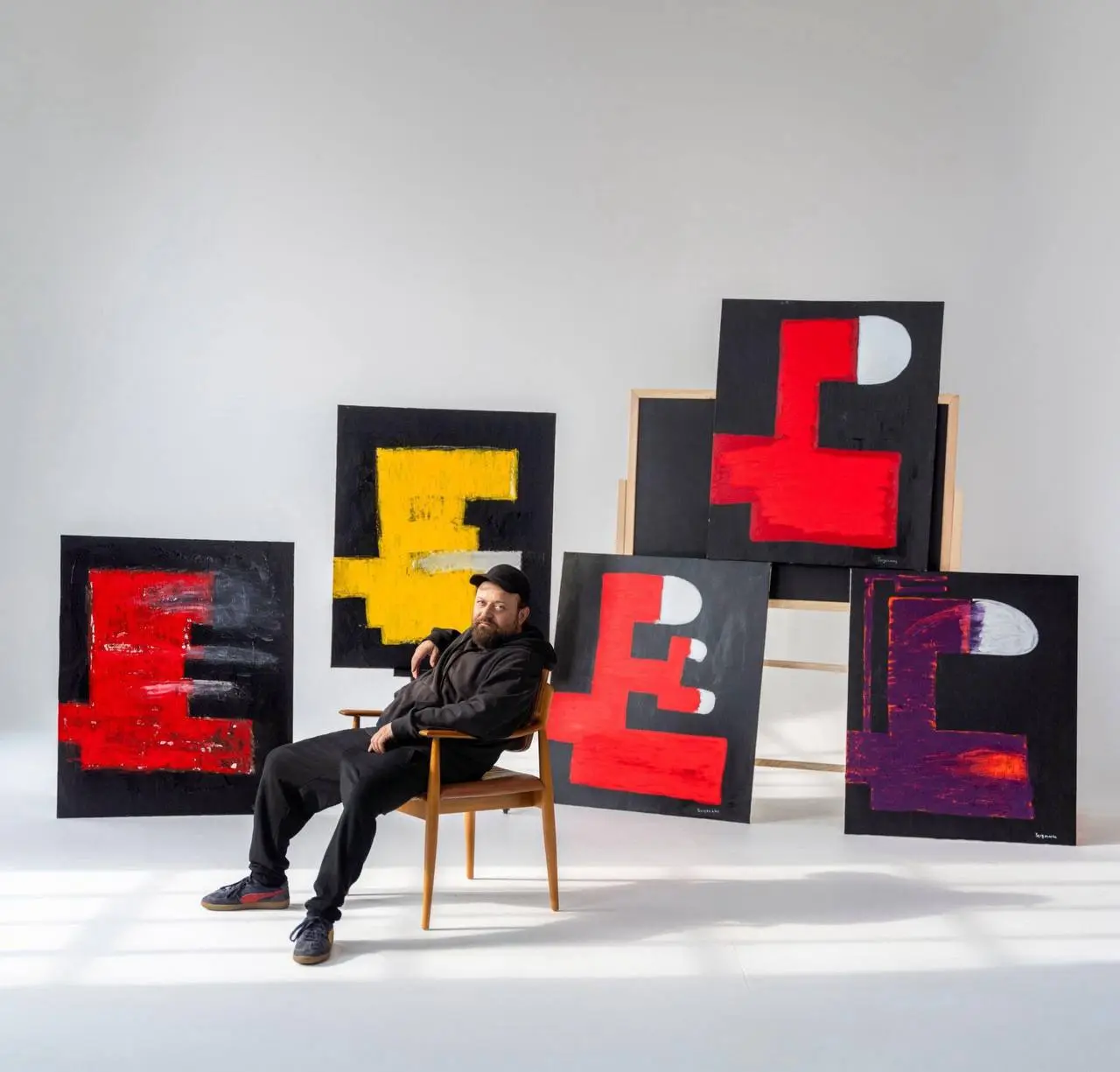
Sergounine works primarily with oil pastel over acrylic ground, developing compositions through repetition, compression, interruption, and controlled abrasion. Each painting evolves under internal constraints — limited palette, fixed scale, and predetermined structural rules that are challenged during the process.
His current body of work, Mind Mechanics (2025– ), explores the unstable architecture of thought through bold, vertically organized compositions that merge organic forms with engineered geometry. Built through cycles of construction and destabilization, the paintings examine memory, instinct, control, and psychological endurance. Rather than depicting figures, the works function as internal diagrams of systems under pressure.
from the series Mind Mechanics
I do not paint to decorate, illustrate, or comfort. I paint to expose the unstable architecture of thought.
Each work begins under constraint: limited palette, fixed scale, strict internal rules. I construct systems of form, then subject them to pressure. Layers collide. Signals are interrupted. Shapes are forced to adapt, fracture, merge, or endure.
The image is not planned in advance. It emerges as the consequence of stress.
The Mind Mechanics are not portraits in the traditional sense. They are diagrams of internal states: structures built from memory, instinct, defense, desire, repetition, and damage. Organic masses meet engineered geometry because the mind is both biological and mechanical — impulse shaped by systems.
I work in closed cycles. Within each cycle, one completed painting is destroyed. Another is permanently removed from circulation during my lifetime. Elimination is structural, not theatrical. Absence is part of the composition of the series.
Color in these works does not symbolize harmony. It functions as voltage, warning, disruption, heat.
What remains on the canvas is not illustration or confession. It is evidence of internal negotiation.
Each painting records a mind attempting to hold itself together under pressure.
Only what survives tension is allowed to remain.